UGC Creator Portfolio: Attract Top Brand Deals
Build a high-converting UGC creator portfolio. Discover niche, AI content, platform choice, & optimization to secure brand deals.
You’ve probably got the raw material already.
A few decent product clips on your phone. A couple of TikToks that looked good. Maybe some story-style videos, an unboxing, a talking-head review, and screenshots buried in old brand DMs. The problem isn’t that you have nothing to show. The problem is that brands can’t evaluate scattered proof.
A strong ugc creator portfolio fixes that. It turns random content into a hiring asset. It shows what you make, who you help, how you think, and why a brand should trust you with its budget.
Why Your DMs Are Not a Portfolio
A message thread is not a business asset.
Neither is a camera roll, a Google Drive folder with no labels, or an Instagram grid that mixes personal posts with one decent skincare testimonial from six months ago. Brands hiring UGC creators don’t want to investigate. They want to scan, qualify, and move.
That matters more now because the category is getting bigger fast. The global UGC platform market is projected to grow from $9.85 billion in 2025 to $35.44 billion by 2030, with a 29.20% CAGR, and 93% of marketers report that UGC outperforms branded content, according to Archive’s UGC market overview.
A bigger market doesn’t automatically mean easier deals. It usually means more creators entering at once. When that happens, the creators who get shortlisted are the ones who look organized and easy to hire.
Practical rule: If a brand manager needs more than a minute to understand your offer, your portfolio is underperforming.
The biggest mistake new creators make is treating a portfolio like a scrapbook. That’s backwards. A portfolio isn’t there to document everything you’ve made. It’s there to help a buyer make a low-friction decision.
What works:
- Clear positioning: “I create conversion-focused beauty UGC” is easier to buy than “I make content.”
- Relevant proof: A product demo for a supplement brand is more useful than a random vacation montage.
- Simple contact path: If someone likes your work, they should know what to do next.
What doesn’t:
- Posting everything: More clips rarely create more trust.
- Hiding your services: Brands shouldn’t have to ask what you offer.
- Forcing them into DMs: DMs are for conversation, not for housing your business.
Treat your portfolio like a storefront, not a chat history.
Foundation First Defining Your Niche and Services
Most beginner portfolios fail before the first video loads.
They fail because the creator hasn’t decided who they want to serve or what they’re selling. If your portfolio says you make content for beauty, SaaS, pets, wellness, travel, fitness, finance, and restaurants, a buyer won’t see range. They’ll see risk.
Pick a niche you can actually support
Your niche should sit at the overlap of three things:
- What you understand: Products you can talk about naturally.
- What you can demonstrate well: Formats that suit your voice, setup, and delivery style.
- What brands buy repeatedly: Categories that need fresh creatives often.
Beauty, tech, lifestyle, food, fitness, and apps are common starting points because they naturally lend themselves to demos, reactions, tutorials, comparisons, and testimonial-style clips. But the right niche isn’t always the broadest one. It’s the one where your examples feel credible.
If you need help narrowing that down, study examples of creator specialization in this guide to choosing a creator niche.
Don’t sell “content.” Sell outcomes and formats
A brand usually isn’t buying “creativity” in the abstract. They’re buying a usable deliverable.
That means your services should be packaged in plain language. Think in terms of what a performance marketer, founder, or social lead can immediately understand.
A simple starter structure looks like this:
| Service type | Best for | What to include |
|---|---|---|
| Single UGC video | Testing one concept | Hook, body, CTA, editing style |
| Content bundle | Launches and product pushes | Multiple angles, variations, thumbnails |
| Monthly retainer | Ongoing paid social or organic posting | Fresh concepts, revisions, recurring output |
| Faceless trend content | Meme pages, app ads, creator-light brands | Reactions, remakes, trend-based edits |
A beauty creator might offer product testimonials, morning routine videos, and before-and-after style demos. A tech creator might focus on app walkthroughs, problem-solution hooks, and feature explainers. A lifestyle creator may package home, wellness, and daily-use product integrations.
What good positioning sounds like
Weak positioning:
- “I create engaging content for brands.”
Better positioning:
- “I create short-form skincare UGC focused on tutorials, testimonials, and paid social hooks.”
- “I produce app demo creatives for mobile products that need quick feature-led video ads.”
- “I make faceless meme-style UGC for brands that want trend participation without on-camera talent.”
A good niche statement makes your next five portfolio decisions easier. A vague one makes every decision harder.
Keep your service menu tight
New creators often overbuild. They list scriptwriting, editing, photography, strategy, community management, consulting, posting, email support, and a dozen add-ons. That creates confusion.
Start with a small menu built around the work you want more of:
Core offer
This is your main deliverable. Usually one short-form video type.Supporting formats
Add related assets that make sense, like alternate hooks, stills, or raw footage.Upgrade path
Offer a bundle or retainer once the buyer understands your main service.
A portfolio gets stronger when the offer is easy to grasp. Clarity beats variety almost every time.
Creating Portfolio Content That Actually Converts
The best portfolio content doesn’t just look good. It answers a buyer’s unspoken question: can this creator make assets my team can use?
That changes how you choose samples. Pretty footage helps, but brands hire based on utility. They want to see whether you can deliver hooks, product clarity, believable delivery, and formats that match paid social or organic needs.
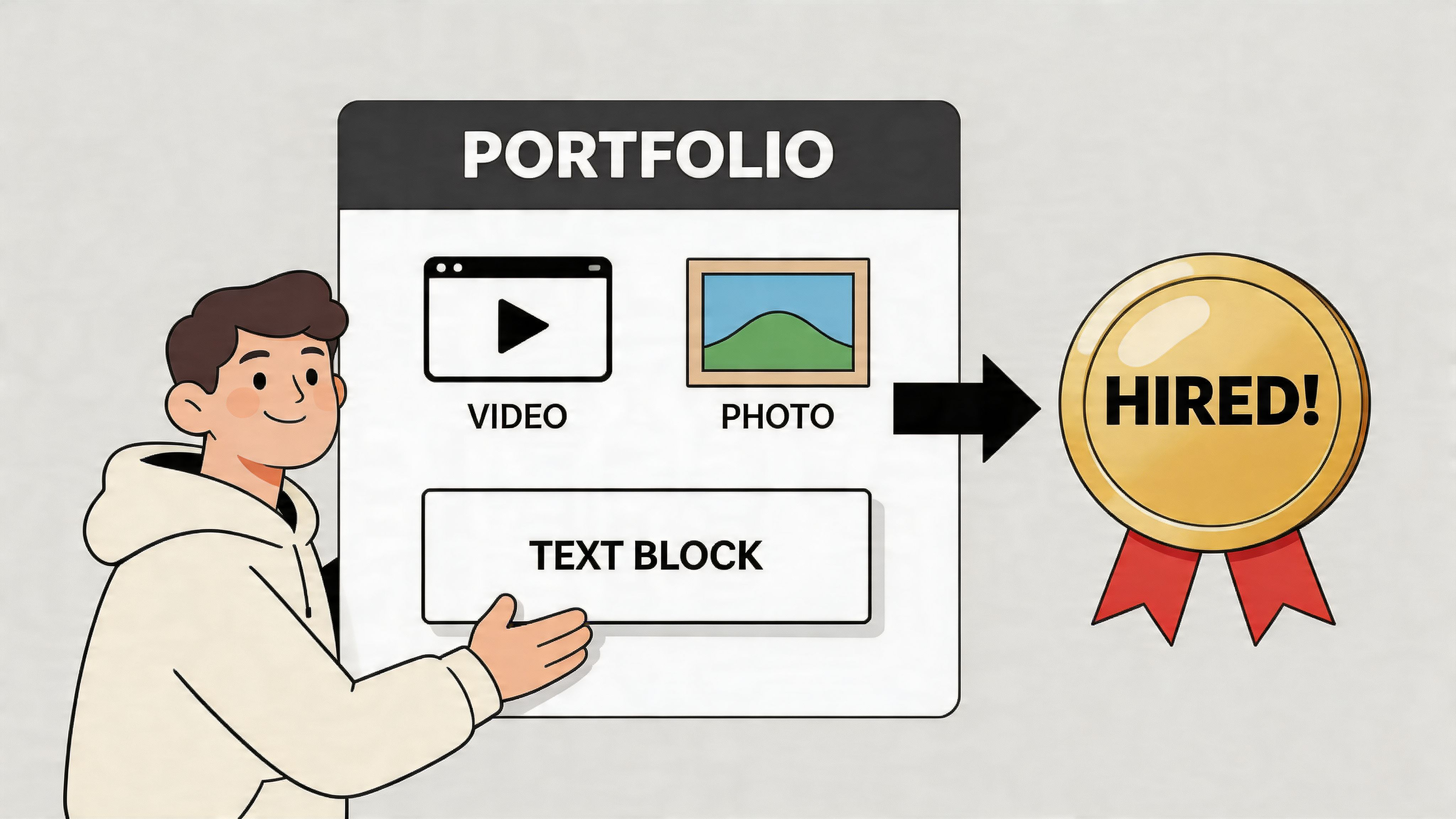
Start with the four portfolio asset types
Your first version doesn’t need dozens of examples. It needs enough range to prove you can execute.
Include a mix like this:
- Testimonial-style videos: Good for trust-heavy categories like beauty, wellness, and household products.
- Product demos: Show that you can explain what the product does without sounding scripted.
- Problem-solution ads: Useful for apps, gadgets, and practical products.
- Trend-adapted clips: Helpful when brands need content that feels native to short-form platforms.
If you have no clients yet, create spec work. Pick products you already use and build realistic samples as if they were paid briefs. Keep the framing practical. A fake collaboration is obvious. A sharp unpaid sample is not a problem if it looks like real campaign creative.
Make every sample carry context
A naked video file doesn’t do enough.
Under each sample, add short notes:
- what the concept was
- who it was for
- the intended placement
- what angle you chose
For example: “Skincare product demo for paid social. Focused on sensitive-skin positioning and simple bathroom-shot authenticity.” That helps a brand understand your judgment, not just your editing.
Brands don’t hire clips. They hire creators who can repeat a useful creative decision.
Show manual skill and scalable workflow
Most portfolio guides stop too early. They tell you to add unboxings, reviews, and tutorials. That’s fine, but it ignores a real production problem.
Some creators spend 4 to 6 hours per video on average, which limits output. The same source notes that AI-integrated workflows have grown quickly, with tools like VidCloner seeing 340% growth in use in 2025, and users reporting a 2.5x higher brand deal conversion rate due to proven speed, according to JoinBrands’ portfolio examples discussion.
That matters because brands often need more than one polished clip. They need iterations, trend-responsive versions, faceless content, reaction-style creative, and fast turnarounds.
A modern portfolio should show both:
- what you can film traditionally
- what you can produce through efficient workflows
That’s especially useful if you’re targeting search intent around cloning viral videos, AI influencer creation, faceless content, or UGC automation.
Good examples for modern portfolio samples
A strong portfolio today can include:
- a talking review filmed on your phone
- a remade meme format adapted for a product category
- a faceless reaction-style video for a SaaS or app feature
- a trend-based clip reworked for a DTC brand
- a side-by-side showing one concept turned into multiple versions
Here’s a practical walkthrough format worth studying:
If you’re building this kind of sample library, keep your workflow page or examples connected to a relevant destination like UGC video creation workflows.
What to cut from your portfolio
Some samples weaken your positioning even if they’re technically decent.
Remove:
- Off-niche experiments that don’t match the work you want.
- Over-edited clips that feel more like motion design than UGC.
- Personal comedy posts unless you want meme or entertainment clients.
- Low-intent visuals with no clear product or message.
A clean filter is simple. Ask: would I want a paying brand to assume this is my standard offer?
Build for repeatability, not one-off brilliance
One great video isn’t enough. Brands want signals that you can keep producing.
So instead of aiming for one perfect hero sample, create mini-sets:
- three hooks for one product
- two versions of the same script style
- one talking-head ad and one faceless adaptation
- one organic-feel version and one paid-social version
That tells a buyer you think like a creative partner, not just a person who occasionally makes a nice clip.
Structuring Your Portfolio for Maximum Impact
Once you have the assets, presentation becomes the differentiator.
A brand manager opening your portfolio is usually scanning, not reading thoroughly. They want to know what you do, whether your work fits their product, and how fast they can move forward if they like what they see.
The basic structure that works
A high-converting ugc creator portfolio usually needs four parts.
A clear hero section
Say who you help, what you create, and what kind of outcomes your content is designed for.A curated work gallery
Group samples by use case, not by upload date.A case study section
Show selected examples with brief context and results where you have permission and proof.A contact path
Add a direct form or email CTA so the next step is obvious.
At this point, many creators lose momentum. They overdesign the homepage and underbuild the logic.
Organize by buyer need, not creator history
Don’t sort your portfolio like a diary.
Better categories include:
- Paid ads
- Organic social
- Product demos
- Testimonials
- Faceless content
- Trend remakes
That structure helps a buyer jump straight to the format they need. A skincare founder looking for conversion-focused clips shouldn’t have to scroll past travel edits and personal lifestyle montages.
Write short case studies that prove commercial value
Authenticity matters because 79% of consumers say UGC highly influences their purchasing decisions, as noted in CreatorLabz’s 2025 UGC statistics roundup. Your portfolio should translate that trust into proof that you understand how to make believable, effective content.
Use a simple case study structure:
| Section | What to write |
|---|---|
| Problem | What the brand needed or what the creative had to solve |
| Approach | Your angle, format choice, hook style, or production method |
| Results | Tangible metrics if available and approved, or qualitative outcome if not |
If you don’t have performance metrics yet, don’t fake them. Describe the brief and your thinking. Explain why you chose a testimonial, a tutorial, a reaction format, or a faceless remake. Smart buyers notice strategic thinking.
The best case studies make a creator look easier to trust because they show decision-making, not just aesthetics.
Your About section should do one job
Don’t write your life story.
Your bio should answer:
- what you create
- which categories you know
- how you work
- why your content feels credible
A few sentences are enough. Mention your niche, your strengths, and the formats you specialize in. If you’re camera-shy or focused on AI-assisted, faceless, or remix-based production, say that directly. The right clients will see that as a feature, not a limitation.
Choosing the Right Platform for Your Portfolio
Where you host your portfolio changes how people perceive it.
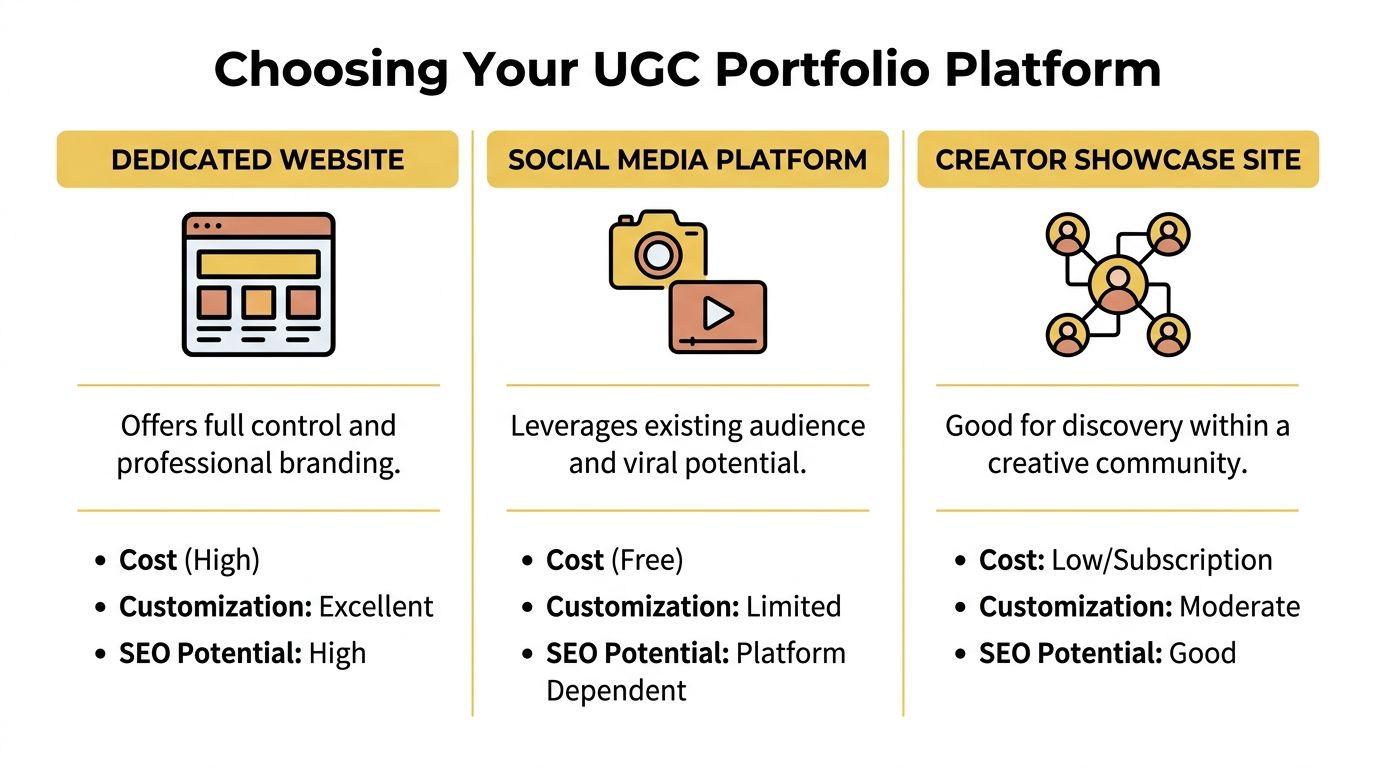
The right platform depends on how established you are, how much control you want, and whether your priority is speed, discoverability, or professionalism. There isn’t one correct answer. There is only the best fit for your current stage.
Dedicated website
A personal site gives you the most control.
That matters if you want custom positioning, case studies, category filters, SEO pages, and a cleaner client experience. A site on Squarespace, Webflow, or a similar builder usually feels more professional than a patched-together social profile. It also gives you room to rank for long-tail searches tied to your niche.
Trade-off: setup takes longer, and you need to maintain it.
Best for:
- creators pursuing repeat brand deals
- niche specialists
- people building a long-term freelance business
Social media platform
Using TikTok playlists, Instagram highlights, or pinned posts is the fastest route.
This works when you need a lightweight portfolio quickly and your content already lives there. It can also help buyers see how your work performs in a native environment. If your editing, hooks, and posting style are your main advantage, social-first presentation can feel more natural than a formal site.
Trade-off: limited control. Your personal content can dilute your positioning, and portfolio navigation is weaker.
Best for:
- early-stage creators
- people with strong existing content libraries
- creators testing demand before building a full site
Creator showcase site
Platforms like Behance, Canva links, Notion pages, or creator-focused showcase tools sit in the middle.
They’re easier to launch than a full website and cleaner than pure social. They’re especially useful if you want one shareable link with embedded video samples, service summaries, and contact details.
Trade-off: they often look template-driven, and some don’t give you enough room for rich case studies.
Best for:
- beginners who need speed
- creators building a first-pass portfolio
- people who want a polished link without a full web build
Quick decision guide
Use this filter:
- Choose a website if you want authority, SEO potential, and stronger control over your sales process.
- Choose social-first hosting if your priority is speed and you already have relevant public examples.
- Choose a showcase tool if you need something clean, simple, and fast to share in outreach.
If you’re pitching brands directly, professionalism matters more than novelty. Pick the platform that makes you easiest to evaluate.
The worst option is usually not the cheapest one. It’s the one that creates friction.
Activating Your Portfolio to Win Brand Deals
A portfolio doesn’t work by existing. It works when you use it in specific selling moments.
The easiest activation point is outbound outreach. Instead of sending a generic intro and hoping a brand asks for more, link directly to the most relevant sample or category page for that prospect. If you’re pitching a wellness brand, send them your testimonial and demo work, not your full homepage.
Use the portfolio inside the pitch
A simple outreach structure works well:
- Open with relevance: Mention the product, audience, or creative gap you noticed.
- Link one matching sample: Don’t make them hunt.
- Offer a specific next step: A test video, concept batch, or intro call.
That approach feels more strategic than “Hi, I’m a UGC creator, here’s my portfolio.” It shows you can map your work to their needs.
Update the portfolio as your business changes
Portfolio strategy should evolve. Research shows that growing creators should showcase variety, while established creators with 12+ months of experience should narrow into their most profitable niche and present case studies with full campaign results to justify premium rates, according to PPC.io’s research on UGC portfolio strategy.
That’s one of the most useful rules in this space.
If you’re newer, your portfolio should prove range within a lane. Show different hooks, product categories nearby your niche, and a few formats. If you’re established, cut aggressively. Lead with your strongest niche, your most repeatable offer, and the proof that supports retainers.
For creators building scalable content systems, faceless production examples, or faster turnaround packages, it helps to align your outreach with a page that reflects that capability, such as this UGC production use case.
A portfolio is a living sales asset. Review it often. Remove weak work faster than you add new work.
Frequently Asked Questions About UGC Portfolios

How many videos should a beginner include in a UGC creator portfolio
Enough to show range without creating clutter.
A good starting portfolio usually includes a small curated set across a few formats, such as testimonial, demo, problem-solution, and one trend-native example. If you have more, only keep the ones that support the type of work you want to sell.
Can I build a portfolio without paid client work
Yes. Spec work is normal when you’re starting.
Use products you already own or know well. Build realistic samples, write short context notes, and present them professionally. Brands care more about whether the work looks usable than whether your first few examples were paid.
Should I put my rates in my portfolio
It depends on your sales process.
Public pricing can filter out poor-fit leads and save time. But if your projects vary by usage, revisions, format, or production method, it may be better to list starting packages or invite inquiries. The key is reducing confusion. Don’t make brands guess what you sell.
What’s the difference between a UGC portfolio and a media kit
A media kit is usually audience-focused. It tells brands about your following, demographics, and collaboration options.
A ugc creator portfolio is work-focused. It shows creative samples, formats, case studies, and service fit. If you’re selling content production more than distribution, your portfolio matters more.
Can faceless creators still land UGC deals
Absolutely.
Many brands need product-led, meme-style, reaction-based, or trend-adapted creative that doesn’t require a traditional on-camera personality. If that’s your angle, make it obvious in your portfolio and show examples that feel native to the platforms where brands publish content.
If you want to build a sharper portfolio around scalable short-form output, trend remakes, AI avatars, and faceless UGC workflows, try VidCloner. It gives creators a practical way to produce portfolio-worthy examples around viral formats without needing to film every concept from scratch.